The 2026 AI Agent Revolution: How Autonomous Reasoning Models & MCP Are Replacing Traditional Software
The AI industry has shifted from simple conversational chatbots to autonomous reasoning agents powered by test-time compute and Model Context Protocol (MCP). Discover how enterprises are automating up to 80% of workflows in 2026.
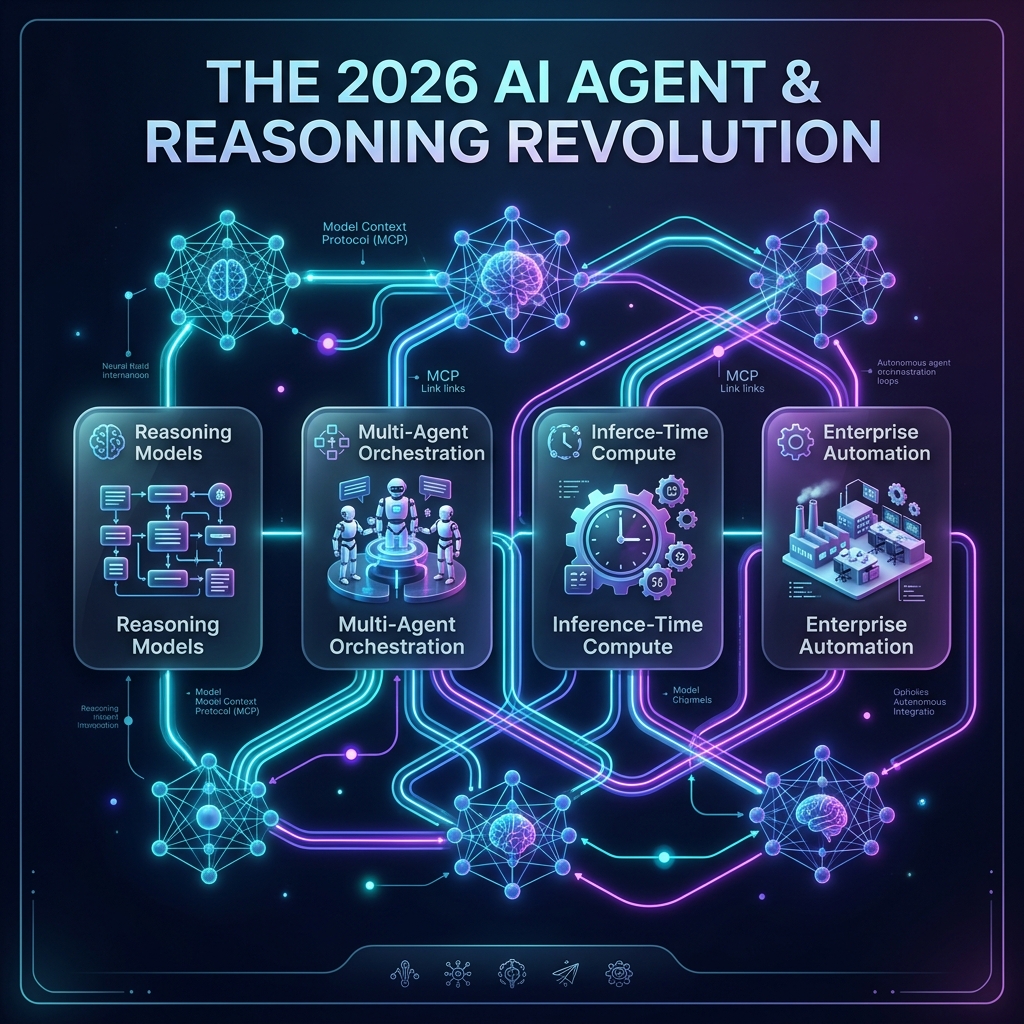
The 2026 AI Agent Revolution: How Autonomous Reasoning Models & MCP Are Replacing Traditional Software
We have entered a pivotal era in software engineering. Over the past three years, artificial intelligence progressed from novelty text generation to conversational chatbots. But in 2026, a fundamental paradigm shift has redefined enterprise technology: the transition from static applications to autonomous reasoning agent systems.
Traditional enterprise software relied on hardcoded conditional logic—buttons, forms, and predefined database triggers. If an edge case arose outside the pre-written code path, the system broke or required human intervention.
Today, frontier AI architectures combine extended test-time compute (inference-time reasoning) with universal agent protocols like the Model Context Protocol (MCP). Instead of humans clicking through software, AI agents act as an autonomous digital workforce capable of planning, tool execution, self-correction, and enterprise automation.
The Paradigm Shift: Chatbots vs. Autonomous Reasoning Agents
To understand why traditional software stacks are being replaced, we must examine the difference between first-generation LLMs and modern 2026 reasoning systems:
| Architectural Metric | 1st-Gen AI Chatbots (2023–2024) | 2026 Autonomous Reasoning Systems |
|---|---|---|
| Execution Model | Instant token stream response | Inference-Time Compute & Chain-of-Thought Deliberation |
| Tool Integration | Custom API glue code per integration | Model Context Protocol (MCP) Universal Standard |
| Workflow Scope | Single prompt-to-response generation | Multi-Agent Orchestration & Iterative Planning |
| Error Handling | Hallucinations on complex edge cases | Autonomous Self-Correction & Verification Loops |
| Enterprise Governance | Policy documents & manual oversight | Governance-as-Code & Automated Guardrails |
1. Inference-Time Compute: Why "Thinking" Beats Model Scale
For years, AI progress was measured almost exclusively by pre-training parameter counts—building larger data centers with tens of thousands of GPUs. However, 2026 has proven that test-time compute (extended deliberation during inference) delivers far higher cognitive capability than raw scaling alone.
When presented with complex architectural problems, financial audits, or multi-repo code refactoring, modern reasoning models do not immediately stream text. Instead, they allocate deliberation compute:
- Internal Monologue & Hypothesis Generation: The model explores multiple potential solutions in a hidden scratchpad.
- Chain-of-Thought Verification: It tests its logic against edge cases before committing to an output.
- Self-Correction Loops: If a flaw is detected in step 3, the agent backtracks and reroutes its execution plan autonomously.
This shift allows enterprise software built by WebNexaLabs to solve non-deterministic problems that previously required teams of senior human engineers or operations specialists.
2. Model Context Protocol (MCP): The Universal Data Highway for Agents
One of the largest bottlenecks in enterprise AI adoption was the N × M integration nightmare: connecting dozens of AI agents to hundreds of disparate enterprise databases, Git repositories, CRMs, and Cloud APIs required thousands of fragile custom connectors.
Enter the Model Context Protocol (MCP)—the standard that has done for AI agents what HTTP did for the World Wide Web.
+------------------------------------------------------------------------+
| AI REASONING ENGINE |
| (Claude 3.7 / GPT-5 / DeepSeek R1) |
+----------------------------------+-------------------------------------+
 |
 MODEL CONTEXT PROTOCOL (MCP)
 |
 +-------------------+------------+-------+--------------------+
 | | | |
+-+-------------+ +-+--------------+ +-+--------------+ +-+--------------+
| DATABASE | | GIT REPOS | | CRM & OS | | CLOUD APIs |
| (Supabase/ | | (GitHub/ | | (WebNexaLabs | | (AWS/Vercel/ |
| Postgres) | | GitLab) | | OS) | | Stripe) |
+---------------+ +----------------+ +----------------+ +----------------+
With MCP, an AI agent can securely read schema definitions, query live operational databases, inspect file trees, invoke server actions, and deploy microservices through standardized, audited tool definitions without custom glue code.
3. Multi-Agent Systems: How Enterprises Automate 80% of Operations
Rather than relying on a single mega-model to perform every task, modern enterprise architectures deploy Multi-Agent Orchestration Workstreams.
At WebNexaLabs, we architect autonomous agent networks structured into specialized roles:
- Supervisor Agent: Receives high-level business goals, decomposes the request into sub-tasks, and assigns work to subagents.
- Specialist Worker Agents: Individual agents optimized for specific tasks—such as automated data extraction, frontend code generation, DB migration, or financial invoice verification.
- Audit & Guardrail Agent: Verifies that outputs meet strict business logic, security constraints, and compliance rules before executing final state changes.
This multi-agent architecture ensures zero single-point-of-failure and guarantees deterministic accuracy for mission-critical operations.
4. Governance-as-Code: Safety in Autonomous Execution
As AI agents transition from passive advisors to active executors, enterprise security is paramount. Modern AI governance has evolved from static policy manuals into Governance-as-Code:
- Real-Time Execution Sandboxing: Agents execute database queries and terminal scripts within isolated sandboxes.
- Human-in-the-Loop Checkpoints: High-risk financial settlements or external communications automatically pause for explicit human approval via interactive UI modals.
- Immutable Audit Trails: Every prompt, internal reasoning step, tool invocation, and API response is logged permanently for compliance audits.
Building the Future with WebNexaLabs
The companies winning in 2026 are not those merely using AI for drafting emails—they are the forward-thinking enterprises embedding autonomous reasoning agents and custom cloud architectures directly into their core business workflows.
At WebNexaLabs, we help startups, growing companies, and enterprises build:
- Custom AI-Driven Enterprise Software & Web Applications
- Autonomous Multi-Agent Automation Pipelines
- Proprietary Internal Systems (ERP / CRM / Cloud OS)
- High-Performance Cloud Architectures
Ready to transform your software infrastructure with cutting-edge AI and custom enterprise solutions?
Explore WebNexaLabs Solutions Schedule a Free Technical Consultation
Manas
Founder & Lead Solutions Architect
Founder of WebNexaLabs & WebNexaLabs OS, specializing in custom enterprise software, AI automation, and high-performance cloud architecture.
Follow WebNexaLabs
Stay updated with custom software, AI automation, and tech growth insights.
Ready to Start Your Project?
Get a free consultation and detailed project estimate. No obligation, just expert advice.
Schedule Free Consultation